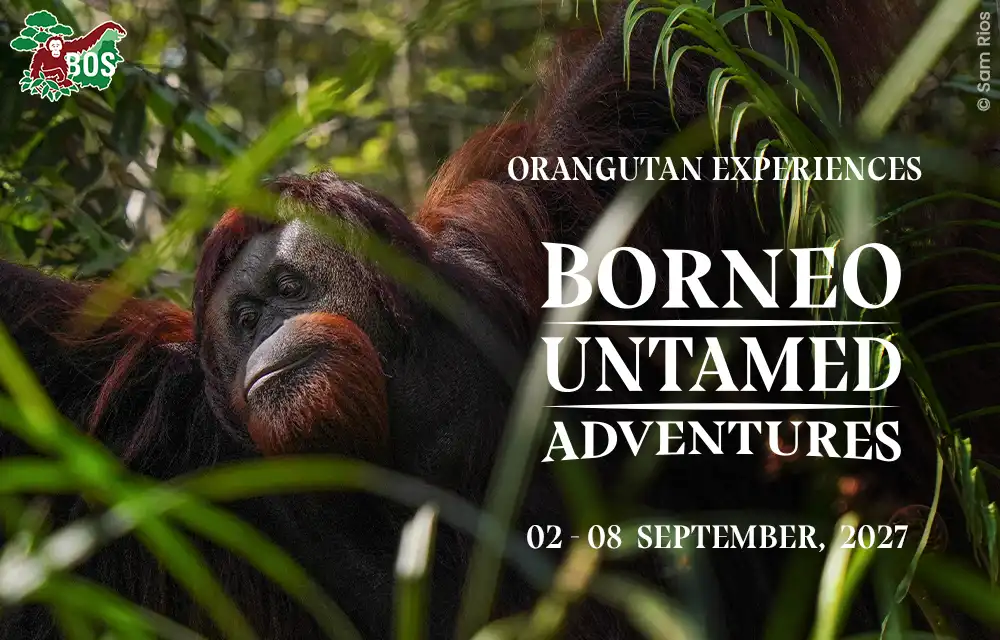


In the Tuanan Research Station, wild male orangutans move through the canopy with remarkable strength and grace. Among them is Dayak: a majestic flanged male whose broad cheek pads signal maturity, dominance, and excellent health.

Dayak is easily recognized by a cleft on his lip. Its unique lip features make it easy for many people, including researchers, to recognize it. In addition, Dayak is also known as a dominant orangutan. His long call often echoes through the forest, serving both as a warning to competitors and an invitation to nearby females.
Despite his massive frame, Dayak moves through the trees with remarkable agility. He swung from branch to branch nimbly and skillfully. Although adult males typically live solitary lives, their role in the forest ecosystem is incredibly important. By traveling long distances and consuming a wide variety of fruits, they help disperse seeds and support the natural regeneration of the rainforest.
One afternoon, Dayak appeared unexpectedly near the Tuanan research station. His presence was calm yet purposeful. Without showing signs of disturbance, he began feeding on tender young leaves from nearby trees.
His movements were quiet but efficient. At nearly every stop along his path, he carefully selected fresh leaves from branches where he paused to rest. The leaves were eaten slowly, as if he was savouring each bite before continuing his journey through the canopy.
Encounters like this provide a rare opportunity to observe the daily life of wild orangutan behaviours up close. Even the smallest behaviours about how they select food, move between trees, or pause to rest, thus are offer valuable insight into their natural routines.
Around three o’clock in the afternoon, while daylight still filled the forest, Dayak began constructing a nest. This was somewhat unusual. Orangutans typically start building their night nests closer to dusk, after a full day of traveling and feeding.
Yet Dayak appeared to have his own plan. As he gathered branches and leaves, he continued eating the young foliage around him. Piece by piece, he wove together a sturdy platform high in the canopy. Before long, the structure took shape—strong, stable, and carefully arranged. What made the nest even more interesting was the leafy cover he built above it. The simple roof formed a natural canopy, providing protection from rain and falling debris.
Not long after Dayak settled into his newly built nest, gentle rain began to fall across the forest. Was this the reason he built his nest earlier than usual? It is impossible to know for certain, but wild orangutans possess remarkable instincts. Their ability to read subtle changes in weather and environment often guides their daily decisions. In Dayak’s case, building his shelter earlier may have been a quiet preparation for the approaching rain.
Dayak represents the resilience, intelligence, and quiet strength of wild orangutans in Borneo. Every movement he makes, such as the fruit he eats, seed he disperses are contributes to the life of the rainforest.
His story reminds us that protecting orangutans also means protecting the forests they depend on. By safeguarding these habitats, we ensure that individuals like Dayak can continue to roam freely through the canopy, playing their role as guardians of one of the most important ecosystems on Earth.
Text by: BOSF Team
Will you help us rescue, rehabilitate, and release orangutans back to freedom? We can only save the orangutan together. Thank you!